
TMT bars are bought by weight and used by length, so every site needs to convert between the two. IS 1786 gives a nominal mass for each diameter; this chart lists it along with the weight of a 12 m bar and the number of bars in a tonne.
The formula
Weight per metre in kg = d² ÷ 162.2, where d is the diameter in mm. For 12 mm: 144 ÷ 162.2 = 0.888 kg/m. The constant comes from steel's density of 7,850 kg/m³.
Weight chart
| Dia (mm) | kg / m | kg / 12 m bar | Bars / MT |
|---|---|---|---|
| 8 | 0.395 | 4.74 | 211 |
| 10 | 0.617 | 7.40 | 135 |
| 12 | 0.888 | 10.66 | 94 |
| 16 | 1.578 | 18.94 | 53 |
| 20 | 2.466 | 29.59 | 34 |
| 25 | 3.853 | 46.24 | 22 |
| 32 | 6.313 | 75.76 | 13 |
Tolerance: why the bundle never weighs exactly the chart
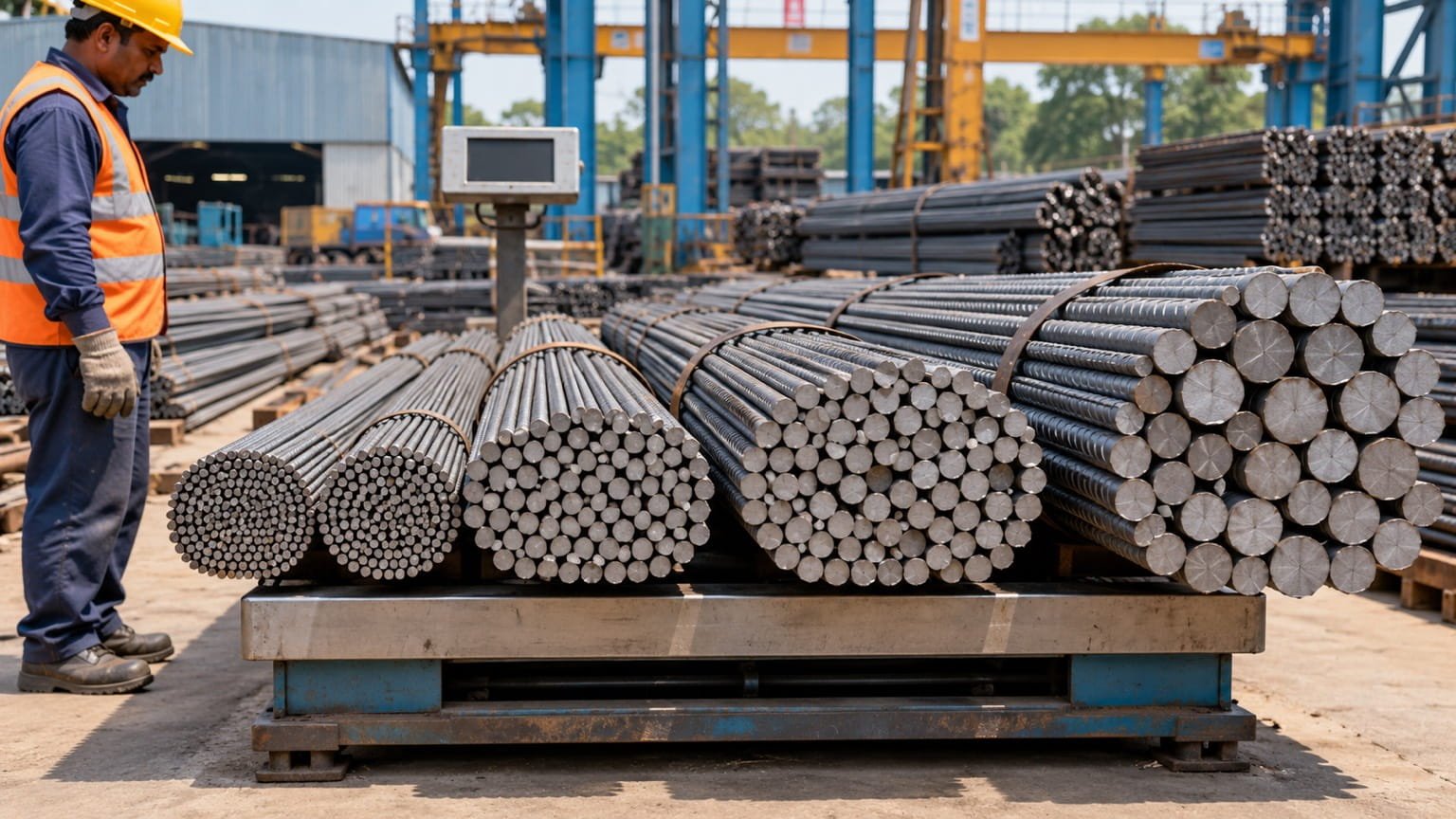
IS 1786 allows a tolerance on nominal mass (around ±7 per cent for 8 and 10 mm, ±5 per cent for 12 and 16 mm, ±3 per cent for 20 mm and above). A bundle can therefore legitimately weigh a little more or less than the chart. This is why suppliers bill on weighbridge weight, not on counted pieces.
Converting a site quantity
Say the bar-bending schedule needs 600 pieces of 12 mm at 4 m. That is 2,400 m × 0.888 kg/m = 2,131 kg, or about 2.13 MT. Add a few per cent for cutting and laps. Our steel weight calculator does this for any size and length.
Cut-to-length saves weight
Buying 12 m bars and cutting 4 m pieces on site leaves no waste, but cutting 5 m pieces leaves a 2 m offcut from every bar. Ordering 8 to 12 mm bars straightened and cut to length avoids that.